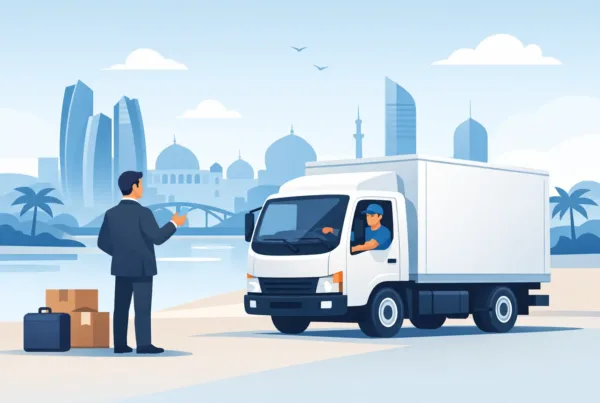



A truck that looks large enough can still be the wrong choice for pallet transport. The real question is not only what truck size fits pallets, but whether it can carry their total weight safely, allow forklift loading, and reach the delivery point without delays. A few pallets of lightweight cartons may fit in a 1-ton pickup, while the same number of steel, tiles, or machinery pallets may require a larger truck.
For businesses, project teams, retail stores, and home movers in Abu Dhabi, choosing the right vehicle protects your goods, keeps loading efficient, and avoids paying for unused capacity. Start with the pallet dimensions, total weight, and site conditions before deciding on a truck.
What Truck Size Fits Pallets Safely?
There is no single answer because pallets are not all the same. In the UAE, a common wooden pallet is approximately 1.2 meters by 1 meter, while some loads use Euro pallets measuring 1.2 meters by 0.8 meters. The footprint tells you how many pallets can sit on the truck floor. The weight tells you whether the vehicle can legally and safely carry them.
A typical pallet may weigh anywhere from 200 kg to more than 1,000 kg once loaded. Bottled goods, paper, furniture, and packaged consumer products are often lighter. Construction materials, metal parts, generators, stone, chemicals, and industrial equipment can be much heavier. Never choose a truck based on pallet quantity alone.
The loading method matters too. If a forklift is loading from the side or rear, an open pickup or flatbed is often the most practical option. If the goods need protection from dust, sun, or weather, a closed box truck may be a better fit. Tail-lift trucks are useful when no forklift is available at the delivery location.
Match Pallet Loads to the Right Truck Size
1-ton pickup truck: small, light pallet loads
A 1-ton pickup is a practical choice for small local deliveries, shop stock, furniture, packed household goods, and light commercial materials. Depending on the truck bed layout and the pallet dimensions, it may carry one to two standard pallets on the floor.
This size works best when each pallet is light and the pickup point and destination have easy access. It is useful for residential moves, retail deliveries, and short-notice work where a large truck would be unnecessary. However, a 1-ton pickup should not be selected for dense materials simply because two pallets physically fit in the bed.
3-ton pickup truck: flexible option for everyday business loads
A 3-ton pickup truck is commonly chosen for three to four standard pallets, depending on their size and how they are positioned. It provides more usable deck space and payload capacity than a smaller pickup, making it a strong option for warehouse stock, office equipment, event materials, and moderate construction supplies.
For many companies, this is the most balanced size. It can handle a meaningful load without being difficult to maneuver around commercial areas, warehouses, or residential streets. If you are moving mixed goods with pallets, boxes, tools, and equipment, a 3-ton truck often gives the extra room needed to secure everything properly.
5-ton pickup truck: heavier loads and larger pallet counts
A 5-ton pickup truck is suitable for approximately five to eight standard pallets in many load layouts. It is a better choice when palletized goods are heavy, tall, or difficult to stack. This size is regularly used for building materials, factory supplies, exhibition equipment, retail fixtures, and bulk deliveries.
The advantage is not only more floor space. A 5-ton vehicle gives more room to distribute the weight correctly, which is essential for safe braking and stability. It also reduces the risk of overloading a smaller truck just to avoid arranging a second trip.
7-ton pickup truck: industrial and project requirements
When a load includes several heavy pallets, a 7-ton truck provides the capacity needed for larger site deliveries and commercial operations. It can often accommodate around eight to 12 standard pallets, though the final number depends on dimensions, stacking height, and load weight.
This truck size is a sensible option for projects in industrial areas such as Musaffah, ICAD, and KIZAD, where deliveries may include machinery parts, fabricated steel, construction products, or production materials. It is also useful when a project requires one organized delivery instead of several smaller vehicle trips.
10-ton truck or flatbed: high-volume pallet transport
A 10-ton truck is designed for substantial loads that are too heavy or too large for standard pickups. It may transport 12 or more pallets, but floor capacity must always be confirmed against the actual truck body and pallet arrangement. For oversized equipment, long materials, or forklift-loaded items, a flatbed may be the more practical choice.
Flatbeds offer open access from the rear and sides, which helps with crane or forklift loading. They are especially useful for equipment, steel structures, large crates, and materials that do not fit comfortably inside a closed body. The trade-off is that open loads may need additional wrapping, strapping, or covering to protect them during transport.
Check These Details Before Booking
Before booking a truck, prepare the information that affects vehicle selection. A clear load description helps avoid sending a truck that is too small, too large, or unsuitable for the loading location.
Provide the number of pallets, their length, width, height, and estimated weight per pallet. Mention whether pallets can be stacked and whether a forklift is available at both locations. If there is no forklift at the receiving point, ask whether a tail lift, pallet jack, or additional handling support is required.
Access conditions also make a difference. A truck may fit the pallet load but face restrictions at a mall loading bay, tower basement, residential entrance, or active construction site. Share information about narrow roads, low-height parking areas, time restrictions, security approvals, and the exact loading and unloading process.
Why Payload Is More Important Than Floor Space
A common mistake is to count how many pallets fit side by side and stop there. This can create a safety problem. Four pallets may fit on a small truck bed, but if each one weighs 800 kg, the vehicle may be overloaded even before tools, straps, and personnel are considered.
Weight should also be distributed evenly. A concentrated heavy load at the rear can affect steering, braking, and suspension. Experienced drivers place pallets to maintain balance, use proper straps and edge protection, and check that the load cannot shift during turns or sudden stops.
Height deserves the same attention. Tall pallets can be unstable, particularly if they are wrapped loosely or stacked unevenly. If the goods are fragile, the truck should have enough interior clearance so nothing is forced, tilted, or loaded unsafely.
Open, Closed, Tail-Lift, or Crane Hi-Up Truck?
The truck body should suit the goods as well as the pallet count. An open pickup is quick to load and ideal for forklift access. A closed truck protects cartons, furniture, electronics, and sensitive stock from outdoor exposure. A tail-lift truck helps when goods must be lowered safely at a location without a dock or forklift.
For heavy machinery, large construction materials, or awkward industrial loads, a crane Hi-Up truck can reduce handling time and improve site safety. It is not needed for every pallet delivery, but it can be the right solution when lifting equipment is not available on site.
Get the Truck Size Confirmed Before Loading
The best pallet truck is the smallest vehicle that can safely carry the full load, handle the loading method, and access both locations without compromise. Choosing too small can mean overloads, delays, and extra trips. Choosing too large can add cost where a more efficient option would do the job.
Fast Movers General Transport LLC provides 1-ton to 10-ton pickup truck rentals, including open, closed, tail-lift, and crane Hi-Up options with experienced drivers available 24/7 across Abu Dhabi. Share your pallet count, dimensions, weight, and pickup details before booking, and the right truck can be arranged for a safer, smoother move.