

A delayed steel delivery can stop an entire worksite. Fabrication teams wait for beams, contractors cannot begin installation, and equipment may sit idle while costs rise. This steel logistics case explains what reliable steel transport requires in Abu Dhabi: the right vehicle capacity, an experienced driver, proper load restraint, and a delivery plan that matches the site conditions.
Steel is not a standard moving load. Its weight, length, edges, and shifting risk require more than simply placing material on a pickup truck. Whether the load is steel plates, rebar bundles, channels, pipes, frames, or fabricated sections, transport must be planned around safety and practical access from collection point to unloading area.
Steel Logistics Case: The Delivery Challenge
Consider a contractor collecting fabricated steel sections from a Musaffah workshop for installation at a commercial site. The materials are ready, but the delivery has several limits. The steel must arrive within a defined receiving window, the site has restricted access, and unloading space is limited. Sending a vehicle that is too small may require multiple trips. Sending one that is too large may create access problems or leave the load poorly supported.
The first decision is not simply how much the steel weighs. Weight matters, but load dimensions matter just as much. A compact but dense stack of steel plates may suit a 3-ton or 5-ton truck, depending on its actual weight and the required safety margin. Long structural pieces may need a longer flatbed trailer even when the total weight is moderate. A crane Hi-Up truck may be the better option when the site does not have a forklift, crane, or enough workers to unload safely.
This is where a transport provider adds real value. The team should ask clear questions before dispatching a truck: What are the item dimensions? What is the confirmed total weight? Is the material bundled or loose? Does the loading location have a forklift? Is there equipment at the destination? Are there access restrictions, gate procedures, or a time slot for receiving?
A correct answer at the booking stage prevents expensive changes after the truck arrives.
Matching the Truck to the Steel Load
For lighter materials, tools, and short steel components, a 1-ton pickup may be practical. It is useful for urgent support runs, but it should never be selected based on volume alone. Steel can reach a weight limit quickly.
A 3-ton or 5-ton pickup truck is often a suitable choice for bundled rebar, plates, smaller fabricated items, and workshop deliveries. These trucks offer flexible access around industrial areas and construction sites while providing more carrying capacity than a standard pickup.
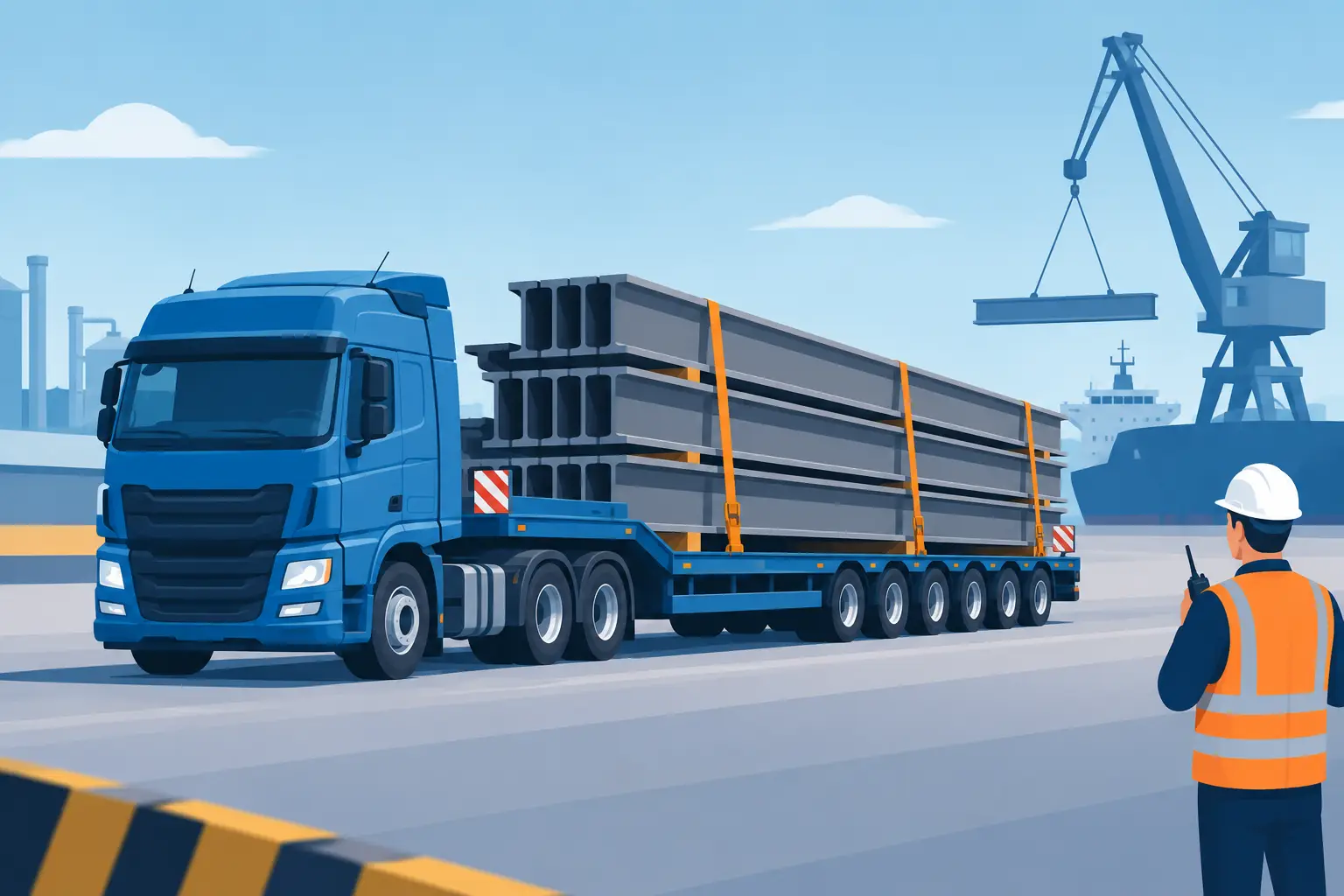
For heavy or long structural sections, a 7-ton or 10-ton pickup truck, flatbed trailer, or crane Hi-Up truck may be required. The best choice depends on the load length, loading method, route, and unloading requirement. A flatbed makes loading and securing long materials easier. A crane-equipped vehicle can reduce dependence on site lifting equipment, but it also needs safe setup space at the destination.
There is no one truck size that fits every steel job. Selecting a vehicle only because it appears cheaper can result in multiple trips, handling delays, or unsafe loading. The efficient option is the vehicle that carries the load legally, securely, and with room for correct restraint.
Safe Loading Is the Core of Every Steel Logistics Case
Steel loads need to be positioned so their weight is distributed properly across the truck bed or trailer. Uneven distribution affects vehicle handling, braking, and tire load. Long sections should be supported at appropriate points to reduce movement and prevent bending or damage during transport.
Experienced loading teams use suitable restraints for the material type. Steel bundles, pipes, and frames can move in different ways, so tie-down methods must be checked before departure. Edge protection may be needed to prevent straps from being damaged by sharp steel corners. Loose items should not be left where they can slide, roll, or fall during turning and braking.
The driver also has a key role. Before leaving, the driver should inspect the load condition, restraint tension, tailgate or side access, and overall clearance. On longer routes or after rough road sections, a load check may be needed to confirm that straps remain secure.
Speed is not the measure of a good delivery. Controlled driving, safe turns, adequate following distance, and careful braking protect the load, the vehicle, and everyone around it. This is especially relevant when transporting through busy industrial areas, near active construction zones, or into locations where pedestrians and equipment are moving nearby.
Timing, Access, and Site Coordination
Many steel transport delays happen at the final destination, not on the road. A truck may reach the site on time but be unable to enter because the gate pass is not ready, the unloading team is unavailable, or materials are blocking the designated unloading zone.
For planned jobs, the site contact should confirm the delivery time, entry process, exact drop-off point, and unloading arrangement before dispatch. If a forklift or crane will unload the steel, it should be ready when the truck arrives. If the truck has a crane Hi-Up, the area must provide enough safe space for operation.
This planning is particularly useful in industrial locations such as Musaffah, ICAD, KIZAD, and Khalifa Port, where projects often operate on scheduled receiving times and site safety controls. It is also valuable for retail fit-outs, event builds, and commercial projects where deliveries must happen around public access or fixed installation schedules.
A reliable rental service remains useful when plans change. A fabrication job may finish later than expected. A contractor may need an additional trip for missing steel components. A site may request an evening delivery after daytime work is complete. Flexible daily, weekly, and monthly truck rental options help businesses manage these changes without maintaining a large vehicle fleet of their own.
Cost Control Without Cutting Safety
The lowest quoted truck rate is not always the lowest project cost. If a truck cannot carry the full load, a second trip adds time, fuel, handling, and waiting charges. If the wrong vehicle reaches the site, the delivery may need to be rescheduled. If material arrives without a safe unloading solution, workers may be forced to wait.
Good cost control begins with accurate information. Share photos of the steel load when possible, along with bundle sizes, approximate weights, pickup and delivery locations, and the equipment available at both ends. This allows the transport team to recommend the correct truck and avoids guessing.
For recurring steel movements, a weekly or monthly rental arrangement can provide dependable capacity for workshop-to-site deliveries, fabrication support, and ongoing project requirements. For one-time deliveries, a daily rental with a professional driver offers a practical way to move material without buying, insuring, maintaining, and staffing a truck.
Fast Movers General Transport LLC SPC provides 1-ton to 10-ton pickup trucks, flatbeds, and crane Hi-Up truck support with experienced drivers available 24/7 across Abu Dhabi. The focus is simple: provide the vehicle and driver that suit the load, arrive ready to work, and support safe delivery from pickup to unloading.
A Better Way to Prepare Your Steel Delivery
Before booking, have the steel weight, dimensions, quantity, pickup contact, destination contact, and unloading plan ready. Confirm whether materials are bundled, whether loading equipment is available, and whether the destination has any access restrictions. These details take only a few minutes to collect, but they can determine whether the job runs smoothly or becomes a costly delay.
Steel transport works best when the truck, driver, load plan, and site team work as one operation. Give your transport provider complete load details early, and the delivery can arrive prepared for the work that waits behind it.